

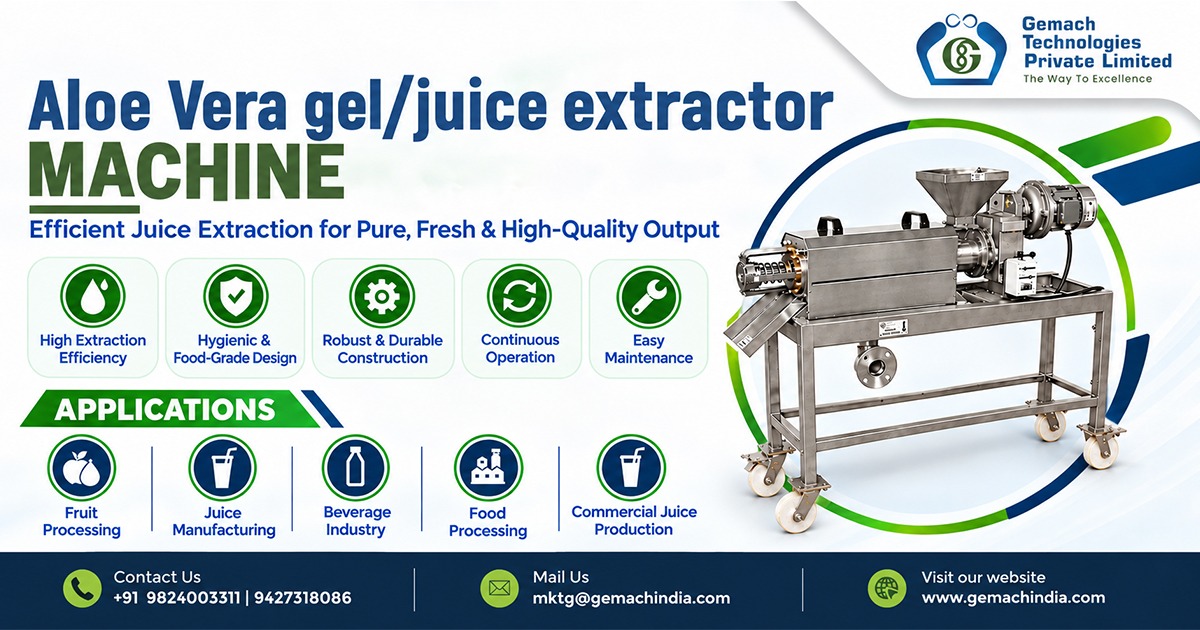
Making Aloe Vera Juice Processing easier requires controlled handling from leaf preparation to gel extraction and filtration. For processors in Ahmedabad and nearby industrial areas, the right extractor can reduce manual handling while supporting hygienic and consistent juice production.
Why Aloe Vera Processing Often Becomes Difficult at Plant Scale
Aloe vera leaves contain valuable inner gel, but separating it from the outer rind requires careful handling.
Common plant-level concerns include:
- Removing the outer rind without excessive gel loss
- Handling sticky and viscous gel
- Managing fibrous material during extraction
- Maintaining hygienic product-contact surfaces
- Moving quickly from extraction to downstream processing
- Keeping the process suitable for the intended production volume
An industrial extractor is therefore not simply a juice-making machine. It forms part of a process in which raw material preparation, extraction, filtration, cleaning, and downstream handling need to work together.
What the Extractor Actually Does in the Processing Line
Gemach Technologies lists configurations ranging from semi-automatic equipment to industrial systems and individual units for peeling, gel extraction, filtration, and filling.
For a typical processing arrangement, the flow can be understood as:
Leaf reception → Washing → Peeling/Filleting → Gel extraction → Crushing/Homogenization → Filtration → Stabilization → Filling
The exact configuration depends on the product formulation, desired output, automation level, and other equipment installed at the plant.
Key Decisions Before Ordering an Extraction Machine
The right choice depends mainly on production volume, process configuration, automation requirements, product-contact material, available space, and downstream equipment.
| Buyer consideration | Why it matters |
| Production requirement | Determines the appropriate machine size and configuration |
| Automation level | Affects operator involvement and process control |
| Leaf preparation method | Influences whether peeling or filleting equipment is required |
| Product-contact material | Important for hygiene and corrosion resistance |
| Filtration requirement | Helps determine downstream equipment needs |
| Available floor space | Influences machine arrangement and access |
| Cleaning method | Should match the plant’s sanitation procedure |
| Future expansion | Prevents today’s equipment from becoming a production constraint |
Buyers should confirm the exact material grade, capacity, configuration, and supplied accessories with the manufacturer before finalizing an order.
A Practical View of the Extraction Sequence
Step 1 – Leaf Preparation
Fresh aloe vera leaves are received and cleaned to remove dirt and surface contaminants. Washing requirements depend on the raw material and plant sanitation procedure.
Step 2 – Rind Removal
The green outer portion is removed to expose the inner gel. This stage needs controlled cutting or scraping because unnecessary removal of useful gel can affect material recovery.
Step 3 – Gel Extraction
The prepared gel enters the extraction or pulping stage. The objective is to convert the gel into a processable juice or slurry while controlling fibrous material.
Step 4 – Filtration
Extracted material can contain remaining fibres or pulp. Filtration helps separate these unwanted solids before subsequent processing.
Step 5 – Downstream Treatment
Depending on the final product, the juice may proceed toward de-aeration, stabilization, pasteurization or other treatment before filling.
Gemach’s published process description includes washing, peeling/filleting, homogenization or crushing, filtration, stabilization and filling as stages that can form part of an aloe vera processing line.
Keeping the Extraction Stage Consistent During Operation
Good operation depends on more than machine selection. Raw material condition and operating practices can also influence the process.
Operators should monitor:
- Condition and cleanliness of incoming leaves
- Feeding consistency
- Extraction flow
- Pulp or fibre separation
- Product-contact cleanliness
- Abnormal vibration or noise
- Leakage around relevant assemblies
- Output consistency
What Buyers Should Verify Before Placing the Order
A supplier discussion becomes more useful when the buyer provides actual process requirements rather than asking only for a machine price.
Ask the supplier to confirm:
- Expected raw-leaf input quantity
- Required processing capacity
- Semi-automatic or automatic configuration
- Required extraction stages
- Product-contact material
- Filtration arrangement
- Cleaning method
- Available floor space
- Electrical and utility requirements
- Integration with existing equipment
- Required customization
- Installation and commissioning scope
- Spare-part availability
- Technical documentation and operating instructions
Services
- Process requirement assessment: Reviewing raw material, production volume, extraction needs, and downstream process requirements.
- Equipment configuration support: Helping identify an appropriate extractor arrangement and automation level.
- Installation and commissioning assistance: Supporting equipment positioning, connections, trial operation, and process integration.
- Technical and after-sales support: Providing guidance for operation, maintenance, troubleshooting, and replacement requirements.
Planning Aloe Vera Extraction With Gemach Technologies
Gemach Technologies Private Limited provides an Aloe Vera / Juice Extractor as part of its industrial equipment range. Its published product information covers semi-automatic and automatic configurations along with individual equipment for peeling, gel extraction, filtration, and filling.
For buyers, the useful starting point is to discuss the complete process requirement rather than selecting an extractor only by capacity. Raw material preparation, desired output, automation, hygiene requirements, plant layout, and downstream processing should all be considered.
Gemach Technologies can be contacted through gemachindia.com for product consultation and requirement discussions. The company provides manufacturing support from Ahmedabad, Gujarat, India, with its listed facility located in the Ahmedabad district.
Frequently Asked Questions
Q: What should I consider when selecting an aloe vera juice extractor?
A: Start with required production volume, raw material preparation, extraction method, automation level, product-contact material, cleaning requirements, available space, and downstream processing.
Q: What material should buyers check for product-contact parts?
A: Buyers should confirm the material grade and finish of all product-contact components. Gemach’s published aloe vera equipment information identifies SS 304 or SS 316L for relevant contact parts.
Q: Is customized aloe vera extraction equipment available?
A: Gemach’s product page states that customized models are available depending on production requirements. Buyers should provide capacity, layout, automation, and process details before requesting a specific configuration.
Conclusion
Efficient Aloe Vera Juice Processing depends on suitable extraction equipment, controlled material handling, hygienic construction, appropriate filtration, and practical plant planning. Buyers in Ahmedabad can discuss capacity, configuration, integration, and maintenance requirements with Gemach Technologies for manufacturing support from Gujarat.
Contact Gemach Technologies to discuss your aloe vera extraction requirement, equipment configuration, plant planning, and technical support needs.
Call Us:
+91 9824003311, +91 9427318086
Email Us:
mktg@gemachindia.com
Info@gemachindia.com